
Kitchen Island Countertops: Materials, Sizes and Edges
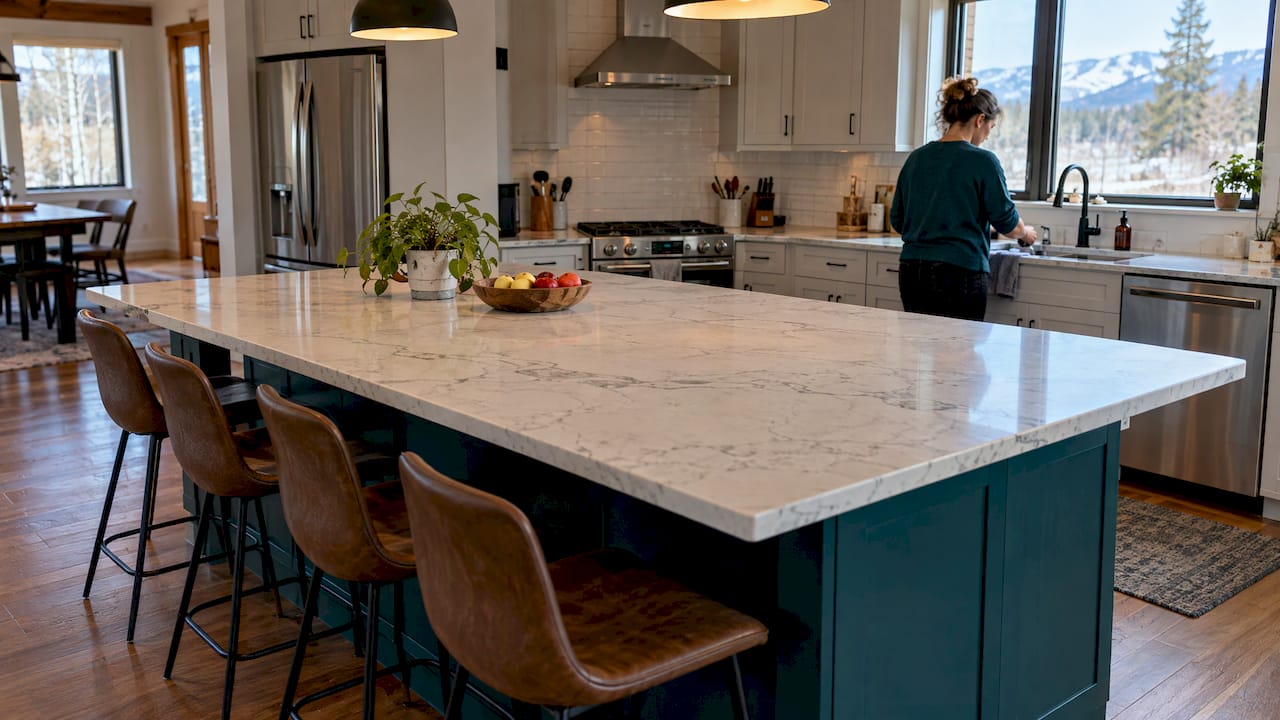
The best kitchen island countertop is the one that fits how you use the island. Cooks who chop and roast at the island want a hard, heat-tolerant top. Families who use it as a homework desk and snack bar want a forgiving surface and a comfortable overhang. Pick the material, thickness and edge together, before the cabinets are final. We sell countertop slabs, set up in-showroom and remote consultations, and send curated samples to your home so you can judge a top in your own light. We ship materials anywhere, and our focus markets are Montana, Wyoming, Idaho and Washington.
TL;DR
-
Quartz and granite both scored at the top in Consumer Reports’ lab tests. Quartz needs no sealing. Granite needs periodic sealing.
-
Use the island as the showpiece. Many designers put the standout material there and keep the perimeter simpler.
-
Plan overhang and support early. For 3 cm quartz, the manufacturer’s manual allows up to 12 inches without added support.
-
Leave at least 42 inches of aisle for one cook and 48 inches for two.
-
Pick the top before cabinets are final, because sinks, cooktops and seating brackets change the cabinet build.
Table of Contents
Start with what the island does
Designer Jamie Gold, writing in Fine Homebuilding, says countertops should never be chosen on looks alone. Start with the family’s habits and needs. Then look at the floor, cabinets and appliances the top has to live with. She also advises choosing the material before the cabinet design is finished, since some tops need special sink accommodations or supports built into the cabinets.
Ask yourself a few plain questions:
-
Will you cook on it, or only serve from it?
-
Do you set hot pans down without thinking?
-
Will kids sit there every morning?
-
Is there a sink or cooktop in the island?
-
Do you want the island to match the walls of counters, or stand out?
Your answers narrow the field fast. A prep island with a sink asks different things of a top than a quiet serving island next to the dining room.
Island countertop materials, side by side
Here is how the common choices behave on an island. We keep price out of this table on purpose. Cost depends on the slab, the edge, the cutouts and the job, so we quote it in writing for your project.
| Material | Looks | Heat | Stains and care | Good island fit |
|---|---|---|---|---|
| Quartz | Consistent patterns, many colors | Resin can scorch under hot pans, so use trivets | Non-porous, no sealing | Busy family islands, frequent cooking |
| Granite | Unique movement in every slab | Handles heat well | Needs periodic sealing | Cooks who want natural stone |
| Quartzite | Natural stone, marble-like veining | Handles heat well | Seal as the stone calls for | Showpiece islands |
| Marble | Soft, classic veining | Fine | Etches from acids, needs sealing | Baking stations, low-traffic islands |
| Butcher block | Warm wood tone | Use trivets | Needs oiling | Prep islands, contrast with stone |
Quartz
Quartz is engineered stone: ground quartz bound with resin. Consumer Reports’ testing found that quartz and granite both survived its stain, hot-pot, knife, heat and impact tests with top scores. Quartz needs no sealing. The same guide notes that quartz edges can chip, and that a pro has to repair them. That is one more reason to choose an eased edge and a good fabricator.
One point trips people up: quartz and quartzite are different materials. Quartz is man-made. Quartzite is a natural stone. Ask which one is on the sample tag. Our quartz vs. granite vs. marble comparison lays out how they differ in care and daily use.
Granite
Granite is a natural stone, so no two slabs match. That is the appeal. It also means the island and the perimeter will not be twins unless you pick slabs side by side. Granite handles heat well and wears hard. Carrie Moore of Carrie Moore Interior Design, quoted in Dwell, says designers like natural stone because the color variation and veining make each piece unique. She also says quality varies widely, so shop carefully. Seeing the actual slab matters, and we can walk you through it in the showroom or by remote consultation.
Quartzite and marble
Quartzite is natural stone with a dramatic look and a hard surface. See our page on quartzite countertops for what we carry. Marble is the softest and most elegant of the group. Ashley Wainscott of Simply Home, also quoted in Dwell, sees marble as ideal for low-traffic spots like baking stations or islands that won’t see heavy use. If your island is more for serving than heavy cooking, marble can be a beautiful pick. Wipe up lemon juice, wine and tomato sauce quickly, since acids dull the finish.
Butcher block
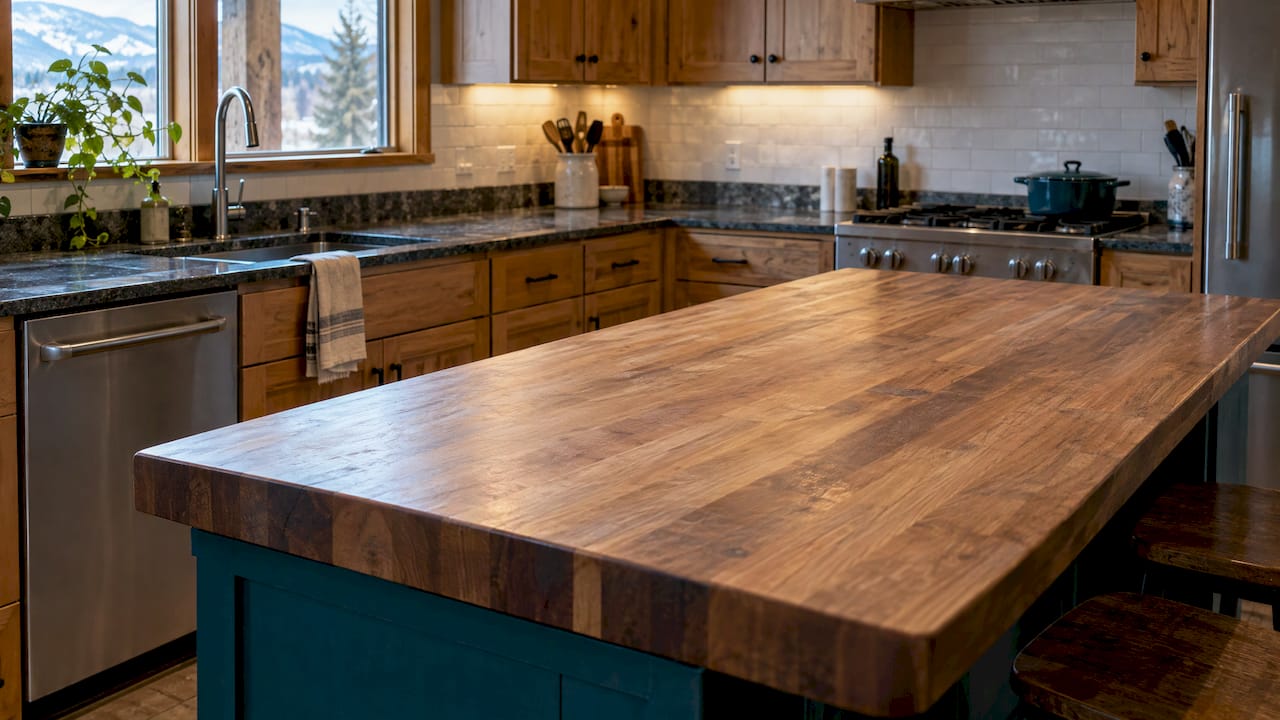
Wood warms up a kitchen and gives your hands a friendly place to chop. It needs oil on a schedule, and it likes a trivet. It also pairs well with a stone perimeter. See our butcher block countertops page for species and finishes.
Match the island to the perimeter, or break the match
The 2020 U.S. Houzz Kitchen Trends Study found that 61% of upgraded kitchens have islands. Of those, 26% use a different island countertop than the perimeter. Butcher block or wood slab was the top contrasting pick at 41%, followed by engineered quartz at 28%, granite at 15%, marble at 7% and quartzite at 5%. About 29% used a contrasting color, led by wood tones and white.
Those numbers say one thing: most people match, and a sizable minority contrast. Both work. Here is how we think about it.
Match it when the kitchen is small, the cabinets are already busy, or you want a calm, uniform look. Same slab, same edge, same finish.
Contrast it when the perimeter is a practical workhorse and you want the island to stand out. A wood island against a stone perimeter is the classic version. A veined stone island against plain cabinets is another.
Split by purpose. Consumer Reports suggests putting the pricier material on prominent areas like an island and a simpler one on the perimeter. It also says remnants can suit smaller areas like an island. If you want a statement top, a remnant can be a clever way to get one. Ask us what is available.
Whatever you choose, tie the two together with one shared element. A matching edge profile, the same undertone in the color, or the same hardware finish will keep a contrasting island from looking like an afterthought.
Island sizes, thickness and overhang
The numbers below are the ones that decide whether an island feels good to use.
Depth and thickness
A standard base cabinet is 24 inches deep. Islands usually run deeper, since you want room for work on one side and seating on the other. A deeper island also gives a seating overhang without crowding the work surface.
For thickness, 3 cm (about 1 1/4 inches) is the usual choice for kitchen stone and quartz. Thinner 2 cm tops need full support underneath, and often a built-up edge to look right. On an island that people lean on and sit at, 3 cm gives you more margin.
Seating overhang and support
The fabrication manual from HanStone, a quartz manufacturer, is specific. It calls for no extra support on 3 cm overhangs up to 12 inches. For overhangs of 13 to 20 inches, it calls for corbels spaced 24 inches on center. It also says an unsupported overhang should never go beyond one-third of the countertop depth.
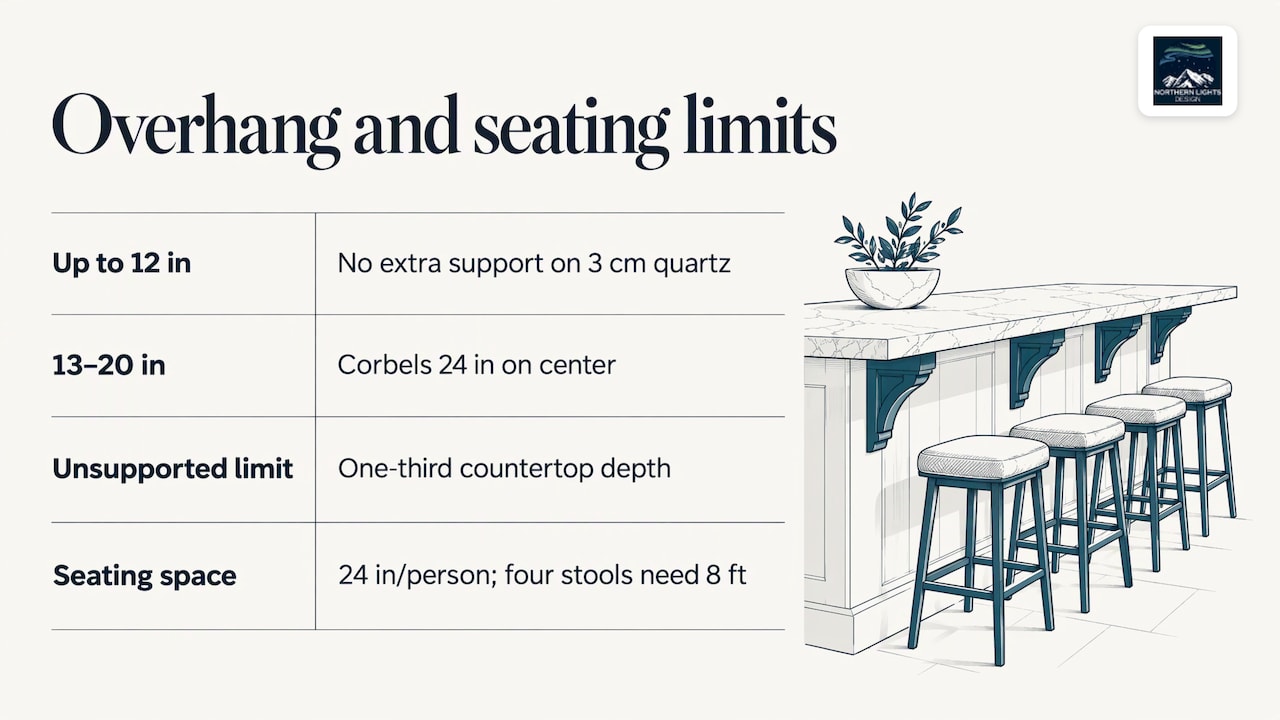
In plain terms: a 12-inch overhang at counter-height stools is fine on 3 cm quartz. Go deeper than that and you need brackets or corbels. Decide now whether you want them visible, like carved corbels, or hidden steel brackets. Either way, the cabinet maker has to know before building.
NKBA knee-space guidance puts comfortable seating at about 15 inches of knee depth at a 36-inch counter. Give each person about 24 inches of width. A four-stool island needs about 8 feet of length for seating alone.
Seams
A standard slab is not unlimited in size. A long island may need a seam. The same HanStone manual says to keep seams at least 6 inches from cutouts and 18 inches from finished ends. Wilsonart’s quartz manual recommends seams 3 inches from dishwashers and cooktops and at least 1 inch from inside corners. Where the seam goes is a layout decision. A good fabricator will show you on a template before cutting. If your island is close to slab length, ask about it at the start. Sometimes a small change in length avoids a seam.
Edges
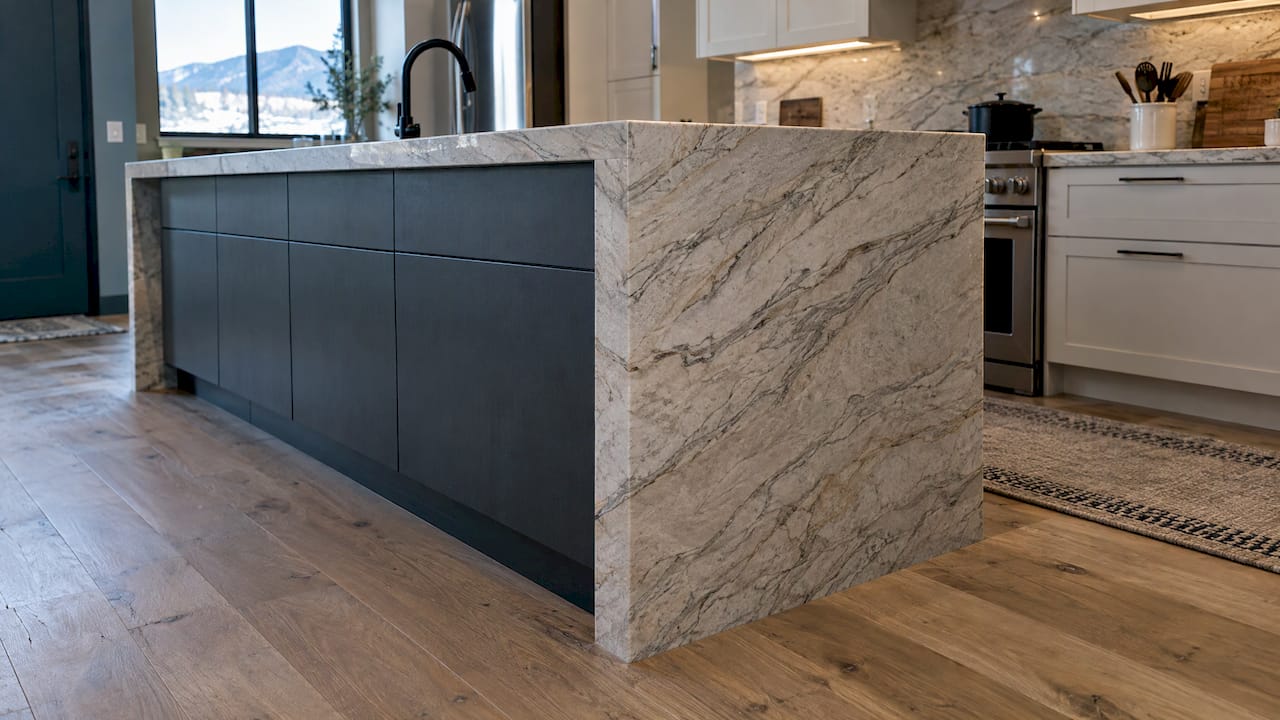
The edge is where countertops take most of their hits. A simple eased edge, with a slightly softened corner, resists chipping better than a sharp square edge. Fancy ogee profiles look great but add fabrication work. On a waterfall island, the stone runs down the sides to the floor. That is a bold look, and it needs careful grain matching at the mitered corners. It is worth talking through with us before you commit.
Clearance around the island
The island can be perfect and still feel wrong if it is too close to the counters. The NKBA Kitchen Planning Guidelines recommend a work aisle at least 42 inches wide for one cook and 48 inches for multiple cooks, measured from counter front to counter front. That is the answer for the space between the perimeter counters and the island.
Some practical notes:
-
Measure from the edge of the overhang, not the cabinet box.
-
If a dishwasher or oven door opens into the aisle, add room.
-
Behind seats, leave space for people to walk past without bumping stools.
-
If your room is too narrow for those aisles, shrink the island before you shrink the aisle.
If the kitchen opens to a staircase or a stepped floor change, treat the nosing and treads as part of the same design. For stair parts, see stair treads and nosing.
Coordinate the top with cabinets and floors
Countertop choice and cabinet construction go hand in hand. Sinks, cooktops and seating brackets all change what the cabinet maker builds. If you are planning custom cabinets, share the countertop details with your cabinet maker early so the fabrication details match the cabinet build.
Then look down. Hardwood, luxury vinyl and tile all pair differently with stone and quartz. A warm hickory floor next to a cool white quartz island looks intentional. Two competing patterns do not. Bring floor samples along when you look at slab samples, and look at both in the room’s real light. We carry hardwood, luxury vinyl and tile and stone, so you can see the full set together.
Kitchen islands in commercial spaces
Islands are not only for homes. Hospitality and retail owners use island-style counters for bars, check-in stations and demo tables. Commercial tops see heavier use, so material choice and edge detail matter even more. Property managers redoing units want consistent material they can reorder. Builders and architects need written quotes and delivery that matches the schedule. We handle this through our commercial flooring, tile and materials procurement service, which includes trade programs and logistics help.
Care for your island top
Mild dish soap and water is the daily clean for most surfaces. For stone and quartz, we cover the details on our countertop care page. If stains are your worry, read what holds up in real kitchens. Use trivets under hot pans on every material. Quartz resin and butcher block both appreciate them.
See the samples in your own kitchen
A small chip under showroom lights tells you little about a 32-square-foot island in your own kitchen. That is why we offer in-showroom and remote consultations, and curated samples you can take home. Set them on your existing counters, next to your cabinets and floor, and look at them in the morning and at night.

We supply countertops and slabs, along with flooring, tile and setting materials, for homeowners, builders, designers and property managers. We ship materials anywhere, and our focus markets are Montana, Wyoming, Idaho and Washington. If you are buying a countertop from us, we can arrange installation for it. Start with our countertops in the Flathead Valley page, or see the whole range on our main site. To learn what the install process looks like, read about countertop installation in Kalispell.
Our view on island countertops
We see the same mistake over and over. People fall in love with a slab picture online, then the island arrives and the color reads differently in their kitchen. Light changes everything. North-facing windows, warm bulbs and cabinet color all shift how a top looks.
That is why we start with a consultation and put samples in your hands. We would rather you take a few home and live with them for a week than guess. The island is the first thing people see, and it is the surface you touch most.
We also like to settle the details early: thickness, edge, overhang, seams, sink and cooktop cutouts. Those choices are easy on paper and costly to change once the cabinets are in. Builders and designers tell us the written quote and the logistics help save them the most headaches. We think the right material is the one that fits your habits, your cabinets and your floor, and we help you get there.
Northern Lights Design Team
FAQ
What is the best countertop for a kitchen island?
For most households, quartz or granite. Both earned top scores in Consumer Reports’ stain, heat, knife and impact tests. Quartz needs no sealing, and granite has the natural variation many people love. Butcher block is a warm choice for prep islands, and marble suits islands that see lighter use.
How much space should be between the counter and the island?
The NKBA recommends at least 42 inches for a work aisle with one cook and at least 48 inches when more than one person cooks. Measure from counter front to counter front, including any overhang.
How far can an island countertop overhang?
For 3 cm quartz, one manufacturer’s fabrication manual allows up to 12 inches without added support. From 13 to 20 inches it calls for corbels or brackets. Your fabricator will confirm what your specific material needs.
Should the island match the other countertops?
Neither is wrong. Matching gives a calm, unified look. Contrasting makes the island a feature. Houzz found that about a quarter of upgraded kitchens use a different island material, with wood the most popular choice.
Can I get samples before I decide?
Yes. We offer curated samples for at-home review, plus consultations in the showroom or remotely.
Talk to us about your island
Ready to pick a top? Contact us at Northern Lights Design in Kalispell, Montana. Tell us about your kitchen, your layout and how you use the island. We will help you choose the material, set the details and get it delivered, wherever your project is.
Sources
-
We Asked the Experts How to Choose the Best Kitchen Countertop, Dwell
-
What’s Popular for Kitchen Islands in Remodeled Kitchens, Houzz